

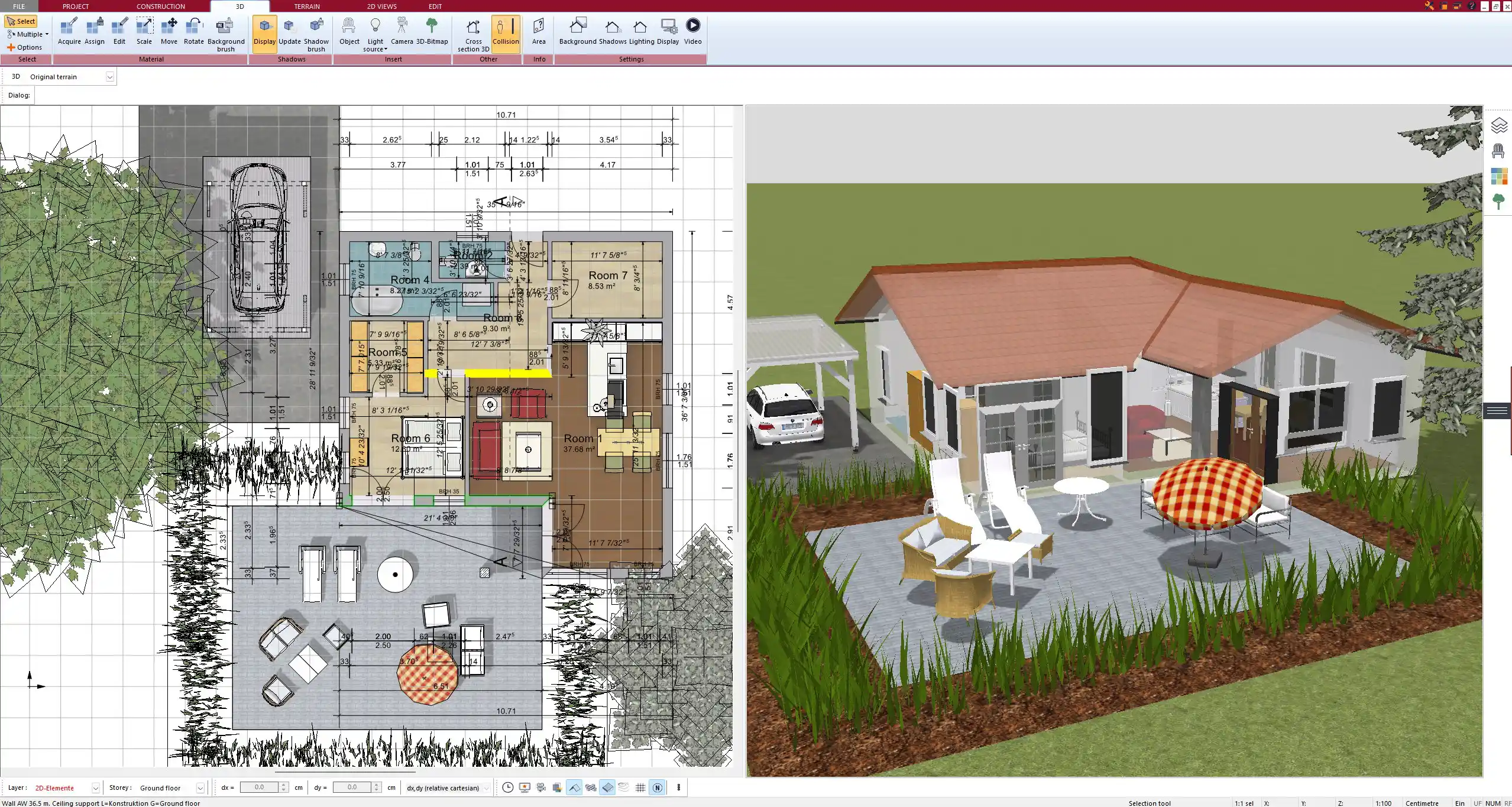
To make your backyard more private, block the sight lines that matter: a 6 ft (1.8 m) fence or hedge along the boundary for views from the ground, and a screen, pergola or tree close to your seating area for views from a neighbor’s upper windows. Plan7Architect lets you draw your yard, fences, plants and patio to scale and check the views in 3D before you buy materials. Heights are set locally: many US towns allow about 6 ft in back yards, and in England 2 m is the limit without planning permission (1 m next to a road).
To keep out wandering eyes and noise pollution, use smart landscaping solutions.

There was a time when you could relax in complete isolation in your own backyard. Then the next-door family cut down some trees on their property. The neighbors’ new master bedroom, on the other hand, offers a second-story porch with wonderful views—into your yard. You suddenly feel as if you’re in a fishbowl.
Privacy is becoming increasingly important as larger residences occupy ever-smaller lots and the demand for outdoor living areas develops. It’s not only about inquisitive eyes invading your personal space; you may also want to filter out your sunbathing neighbors’ chatter.
Without a fence, how can I get privacy in my backyard?
The first answer that comes to mind is usually a fence. There are a variety of options for creating privacy in your backyard without a fence, ranging from perimeter plantings to stone walls or garden structures.
How to keep your backyard from being seen by your neighbors
Here are some of our favorite backyard privacy ideas to get you started.
Wooden planks that are staggered
Soft colors of black, yellow, green, and red stain the staggered wooden boards. They create a one-of-a-kind privacy fence with a feathery tree canopy overhead and bushes in front.
Personal privacy hedges
This privacy landscaping idea can provide year-round screening and is often unrestricted by height restrictions imposed by municipal ordinances. Fast-growing columnar evergreens like Italian cypress and arborvitae, as well as a shorn privet hedge, can provide a simple solution for separating adjoining yards or concealing sight lines out a kitchen window where space is limited, such as in a side yard.
Create a two-foot-wide, two-foot-deep hole for a new private hedge, place individual bushes approximately 12 inches apart, and bring soil up to the branching trunk. The first year, use drip irrigation to water thoroughly and often. These deciduous shrubs demand a temperate climate and a homeowner who is ready to use sharp shears as often as necessary to thrive.
Plantings for privacy in layers
Planting a mix of deciduous or evergreen trees, shrubs, and perennials in bigger yards produces a more naturalistic effect, especially if the plants are layered and grouped in odd numbers. To provide texture, depth, and color, stagger evergreens in the background and step down the height in the foreground with deciduous material.
Planting deciduous shade trees—which range in height from 25 to 60 feet depending on the species—is an effective technique to block a neighbor’s view from a second-story window or terrace. The canopy gives privacy and shade in the summer when placed over a deck or patio. The naked branches of the trees allow the sun to shine into the house in the winter.
Container gardens for deck privacy
Clumping bamboo can be used to create a green screen surrounding a seating area on a raised deck. Pots should ideally be elevated on casters or constructed of lightweight materials so that they may be readily moved for parties or deck repairs.
Fences and walls
Pools, patios, and playgrounds that have recently been erected may demand a visual boundary in a hurry. A 6-foot solid board fence is the simplest option to establish year-round privacy in your backyard; however, verify local construction laws for fence heights. Fences have a smaller footprint than plantings, so they may be the ideal option in a side yard where space is limited.
Board fences are available in a variety of styles to match the architecture of your home, and they can be stained to match the house. However, while a privacy fence may alleviate the problem, it isn’t necessarily the most attractive option.
Also, metal gates are excellent for securing your property. Intruders and robbers are deterred by having a robust metal gate or fence surrounding their home. Customized gates can also add value to your home by providing a solid security precaution for future owners.
Fencing on top of a stone wall
A shorter 3- or 4-foot lattice or picket fence mounted on top of a 2- or 3-foot stone wall is another option. From afar, the wall is tall enough to block sight lines, while the openwork fence provides privacy without feeling claustrophobic.
Ornamental ironwork on masonry walls
Similarly, when windows are cut into a 5- or 6-foot-high masonry wall of stone or stucco, it feels less imposing; often, beautiful ironwork can decorate such holes.
Panels and pergolas
Screening defined areas such as small patios, outdoor kitchens, and decks is typically easier than screening an entire yard. You can re-create the intimate sense of eating or partying indoors while still enjoying the great outdoors by erecting an enclosure around them.
A slatted-top wooden pergola covered with climbing vines on a patio or a set of fixed lattice panels along two sides of a raised deck are examples of enclosures. Prefabricated iron gazebos can be placed directly on the ground, with potted vines and hanging baskets filling in the spaces.
Ornamental ironwork, lattice, and wood panels
Lattice screens, shutters like louvered wood panels, or pieces of ornamental iron with anchoring posts can be buried to enclose a pleasant area or create a U-shaped structure that maintains good views. Consider putting the post ends in lightweight planters with wheels for maximum flexibility; to anchor them, add concrete plugs to the feet or place the posts in gravel. When you’re entertaining, you can shift them around to make more open space.
Although semi transparent structures can not give complete privacy, they do add visual appeal to a landscape while allowing natural light and breezes to pass through.
Using fountains to mask noise
Even if you don’t agree with your neighbors on everything, you may be close enough to hear their talk. Alternatively, you might be irritated by obtrusive traffic noise or buzzing air conditioner compressors. In such instances, including a fountain in your privacy plan might provide nice white noise to conceal undesirable sounds. These can range from plug-in devices that sit on a table or hang on the wall to unique designs that become the focal point of the room.
Which Backyard Privacy Idea Fits Your Yard?
Each idea solves a different problem. A fence or wall works at once and needs little space, plants take years but look softer, and screens near the seating area are the quickest answer to views from above.
Backyard privacy ideas compared
Typical values; heights and growth depend on species, climate and local rules.
| Idea | Typical height | Privacy | Works after | Space needed |
|---|---|---|---|---|
| Solid board fence | 6 ft (1.8 m) | Full, all year | Right away | Very little |
| Evergreen hedge (arborvitae, privet) | 6 to 15 ft (1.8 to 4.5 m) | Full once grown | Several years | About 3 to 5 ft (1 to 1.5 m) |
| Layered trees, shrubs and perennials | Mixed | Natural, partial to full | Several years | A lot, best for bigger yards |
| Bamboo in containers | Depends on pot and variety | Partial | One season | Little, and movable |
| Stone wall with fence on top | 2 to 3 ft wall plus 3 to 4 ft fence | High, less closed-in | Right away | Little |
| Pergola or lattice panels | Around the seating area | Partial, overhead too | Right away, vines take longer | Only around the seats |
| Deciduous shade tree | 25 to 60 ft (8 to 18 m) | From upper windows, in summer | Many years | A lot |
| Fountain | Not relevant | Masks sound only | Right away | Very little |
How to Block a Neighbor’s View into Your Backyard
A view from a neighbor’s second-story window comes in at a steep angle. A boundary fence would have to be far taller than local rules allow to stop it, while a screen, a pergola with climbing plants or a small tree right next to your patio or deck blocks the same line with a fraction of the height. The closer the screen is to the spot you want to hide, the lower it can be.
Why a screen near your seat beats a taller fence
Example to scale: the neighbor’s window is 13 ft (4 m) behind your fence at an eye height of 15 ft (4.6 m); you sit 20 ft (6 m) from the fence. The 7 ft screen stands 5 ft (1.5 m) in front of you.
For views from the ground, the boundary is the right place: a fence or hedge of about 6 ft (1.8 m) hides a standing adult. If you need to know where your patio should go in the first place, see how big a patio should be.
Privacy Fence Height: How Tall Can a Backyard Fence Be?
Fence heights are set by your city, county or homeowners association, not by a national rule. In many US towns, back and side yard fences may be about 6 ft (1.8 m) high and front yard fences 3 to 4 ft (0.9 to 1.2 m); some allow up to 8 ft (2.4 m) behind the house. The model International Residential Code exempts fences up to 7 ft (2.13 m) from a building permit, but cities often change that. In England, you can usually build a fence or wall up to 2 m without planning permission, or 1 m next to a road used by vehicles, unless your property has special restrictions.
What a fence height hides
Common fence heights drawn to scale. A 4 ft (1.2 m) fence only just hides someone sitting; you need about 6 ft (1.8 m) to hide a standing adult.
How to Plan Your Backyard Privacy in Plan7Architect
Privacy depends on heights, distances and angles, which are hard to judge on a sketch. In Plan7Architect you draw your plot to scale and check it in 3D:
- Draw the plot. Enter the property lines and the terrain, then place your house and, if it matters, the outline of the neighbor’s house.
- Add the outdoor areas. Draw the patio, deck, terrace or pool where you want to sit. For sizes see how big a deck should be.
- Place the screens. Add fences, walls and plants from the large 3D object catalog at their real heights.
- Check the views in 3D. Walk through the garden in 3D and look at your seating area from different points to see which gaps are still open.
- Check sun and shade. Use the sun and time-of-day simulation to see how much shade a tree, pergola or fence casts on the patio.
- Share the plan. Export the plan as PDF for your landscaper or fence builder, or as DWG or DXF.
More on garden planning with software: 3D garden planner software.
FAQ: Making Your Backyard More Private
How can I block my neighbor’s view of my backyard?
For views from the ground, use a fence or hedge of about 6 ft (1.8 m) on the boundary. For views from a neighbor’s upper windows, put the screen close to where you sit: a pergola with climbing plants, lattice panels, a row of tall planters or a tree next to the patio blocks the steep sight line with much less height.
How can I get privacy in my backyard without a fence?
Plant an evergreen hedge or a layered border of trees, shrubs and perennials, use bamboo or tall grasses in containers, or build a pergola, lattice screens or a low stone wall with an open fence on top. A fountain helps with noise from the neighbors or the street.
How tall can a privacy fence be?
It depends on your local rules. Many US towns allow about 6 ft (1.8 m) in back yards and 3 to 4 ft (0.9 to 1.2 m) in front yards; some allow 8 ft. In England the limit without planning permission is usually 2 m, or 1 m next to a road.
Do I need a permit for a privacy fence in Plano or other Texas cities?
Texas cities such as Plano set their own fence rules, including permits, maximum heights and materials, and many neighborhoods add HOA rules on top. Check with the city’s building inspections department and your HOA before you order a fence.
What is the cheapest way to make a backyard private?
Fast-growing plants, bamboo in containers and ready-made lattice or reed screens cost less than a long solid fence, and you can concentrate them around the seating area instead of the whole boundary. A fence costs more up front but gives full privacy right away.
Can I plan backyard privacy online or for free?
For a first sketch, a free garden planner is enough; this overview compares the options: best free garden planners. To check heights, terrain and views to scale in 3D, together with your house, Plan7Architect Pro is available for a one-time price.
See Your Private Backyard in 3D Before You Build
A fence in the wrong place or a hedge that is too low is expensive to correct. With Plan7Architect Pro you plan the whole yard, from fences and plants to patio and deck, and check the views in 3D first.
Plan7Architect Pro costs Original price was: $259.99.$99.99Current price is: $99.99. as a one-time payment. No subscription, as many projects as you like, and you can install it on up to 3 PCs. If it is not right for you, you are covered by a 14-day money-back guarantee – a short email is enough.
Watch how a complete house is planned from start to finish – in under 25 minutes


The 3 Plan7Architects
Basic · Expert · Pro
Which version is right for you?

- Work in parallel in 2D & 3D
- Interactive dimensions
- Furnish rooms – over 15,000 3D objects
- 3D visualization in real time
- Tutorial videos, manual & support tickets

- Everything in Basic, plus:
- Automatic roof & staircase construction
- External dimensions & living-area calculation
- Automatic room detection & snap points
- Panorama backgrounds & individual lighting
- Over 30,000 3D objects & sample projects
Not included: building permit plans, sections & elevations and export to your architect – only in Pro 6.
View Expert
- Everything in Expert, plus:
- Building permit plan sets, sections & elevations
- International building standards (US, UK, CA, AU, EU)
- Garden, terrain & site planning
- Send plans to your architect or builder (PDF, DWG, DXF)
- Wood framing for walls & roofs
- Electrical, heating & plumbing planning
- Several million 3D objects (SketchUp)
- Twinmotion Direct Link, VR & 3D printing
- Export for AI renderings, AI videos & material lists
- … and much more