How to Create a Building Plan with Elevations and Dimensions

If you want to create a complete building plan with elevations and precise dimensions in Plan7Architect, the process is straightforward: you draw the floor plan in exact measurements, define wall heights and structural elements, generate elevations automatically from the 3D model, add dimension lines, arrange the views on a layout sheet, and print or export the plans to scale.

Plan7Architect allows you to create:

  • Scaled floor plans with exact wall lengths and room sizes

  • Exterior elevations for all sides of the building

  • Section views with vertical dimensions

  • Roof plans

  • Fully dimensioned construction drawings

  • Printable sheets in standard architectural scales

  • Output in PDF and common CAD formats

You can work in metric units such as meters, centimeters, or millimeters, or in imperial units such as feet and inches. The unit system can be adjusted inside the software, so you can plan according to local standards without manual conversions.

In practice, I start every project by setting up the units and scale, then draw the outer walls using exact numeric input. After placing windows and doors with precise sizes, I insert dimension lines and switch to elevation views, which are generated automatically from the model. Within a short time, I have a complete building plan that can be printed to scale or shared digitally.

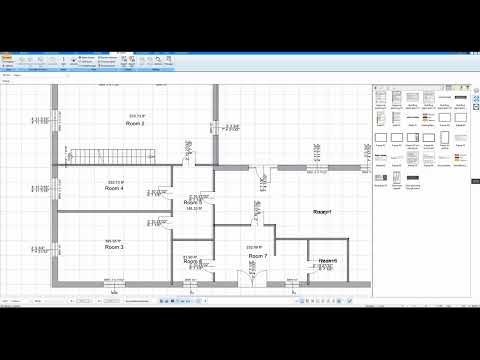
Building floor plan with precise dimensions created in Plan7Architect

What Is Included in a Complete Building Plan?

A professional building plan is more than a simple floor layout. It includes horizontal views, vertical views, and detailed dimensions that clearly communicate the structure of the building.

Floor Plan with Dimensions

The floor plan is the foundation of your entire project. In Plan7Architect, you define:

  • Exterior wall lengths

  • Interior wall layouts

  • Room dimensions

  • Door and window sizes

  • Wall thicknesses

  • Structural openings

  • Stair positions

  • Load-bearing and non-load-bearing walls

You can enter wall lengths numerically, for example 10.00 meters or 32 feet, depending on your chosen unit system. The precision can be set down to millimeters or to fractions of an inch.

Dimensioning options include:

  • Automatic exterior dimensions

  • Automatic interior room dimensions

  • Manual dimension lines for specific details

  • Chain dimensions

  • Overall building dimensions

The following table summarizes common dimension types used in building plans:

Dimension Type Purpose Typical Use
Overall Dimensions Show total building width and length Site planning, permit drawings
Exterior Wall Dimensions Show distances between outer corners and openings Construction layout
Interior Room Dimensions Show usable room sizes Space planning
Opening Dimensions Door and window width and height Framing and installation
Vertical Dimensions Floor-to-ceiling height, ridge height Elevations and sections

You can control text size, arrow style, line thickness, and formatting so the plan remains clean and readable.

Exterior Elevations (Front, Rear, Left, Right)

Once the 3D model is created from your floor plan, elevations are generated automatically. You simply select the desired side of the building.

Each elevation typically shows:

  • Wall heights

  • Roof slope and ridge height

  • Window and door positions

  • Exterior finishes

  • Ground line

  • Height dimensions

The elevation scale can be adjusted to common architectural standards, such as 1 to 100 or 1 to 50 in metric regions, or 1 quarter inch equals 1 foot in imperial regions. Plan7Architect allows you to set the scale according to your local requirements.

In my own workflow, I usually:

  • Switch to elevation view

  • Add vertical dimension lines for total height and floor levels

  • Insert notes if required

  • Adjust line weights for clear black-and-white printing

This results in a clean elevation drawing suitable for contractors or planning discussions.

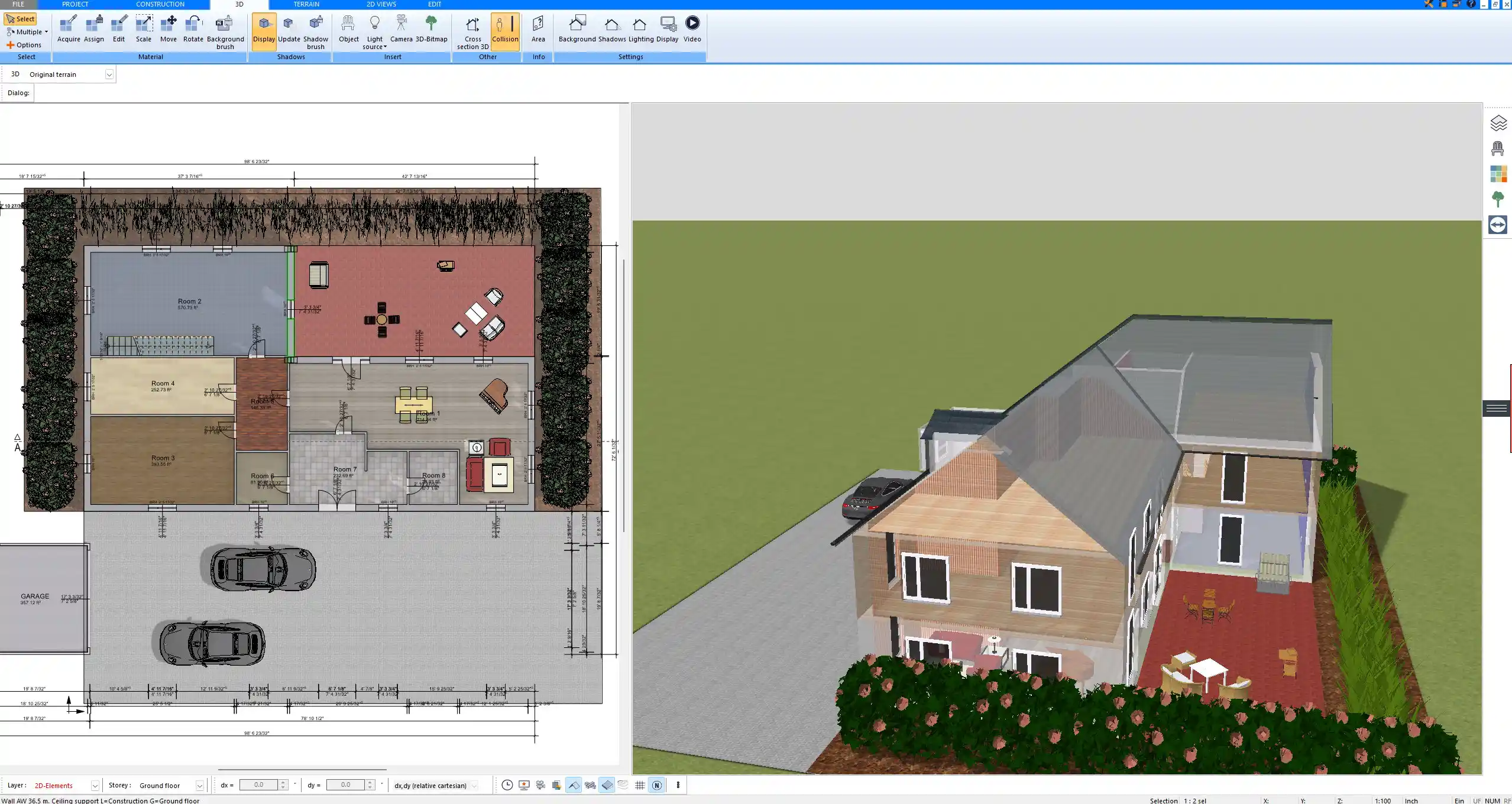
Fully dimensioned ground floor layout designed in Plan7Architect

Section Views

Section views are essential when you need to show structural relationships. In Plan7Architect, you define a cutting line through the building, and the software generates a sectional view.

A section view typically includes:

  • Floor structure

  • Ceiling height

  • Roof construction

  • Foundation depth

  • Slab thickness

  • Structural elements

Vertical dimensions can be added for:

  • Floor-to-floor height

  • Floor-to-ceiling height

  • Total building height

  • Roof peak

For construction planning, I always verify these vertical dimensions carefully before printing.

Step-by-Step: Creating a Building Plan with Elevations and Dimensions

Step 1 – Set Project Units and Scale

Before drawing anything, open the project settings and define:

  • Unit system: metric or imperial

  • Dimension display format

  • Precision level

  • Default drawing scale

This prevents inconsistencies later. Changing units mid-project is possible, but setting them correctly at the start ensures clarity.

Practical tip:

If you work with contractors in different countries, verify the required unit system before you begin.

Step 2 – Draw the Floor Plan

Use the wall tool to create the outer structure. Instead of drawing freely, enter exact values using the keyboard.

For example:

  • Enter 12.00 meters or 40 feet for the exterior wall

  • Define wall thickness, such as 300 millimeters or 12 inches

After the outer shell is complete:

  • Insert interior partition walls

  • Add doors and windows with exact width and height

  • Position structural elements

  • Define floor levels

Because the software builds a 3D model automatically, every change in the floor plan updates the elevations and sections.

Step 3 – Add Dimensions

Dimensioning is not just decorative. It defines the usability of your plan.

In Plan7Architect, you can:

  • Activate automatic exterior dimensions

  • Add manual dimension chains

  • Place interior room measurements

  • Adjust dimension spacing

  • Choose decimal or fractional display

A well-dimensioned floor plan typically includes:

  • Overall building length and width

  • Distances between structural axes

  • Room sizes

  • Door and window widths

  • Wall offsets

Keep the drawing readable. Avoid overcrowding the plan with redundant dimensions.

Important note:

Always double-check dimension placement after moving walls or openings.

Step 4 – Generate Elevations

Switch to elevation mode and select the building side you want to display.

From there you can:

  • Adjust view scale

  • Add height dimensions

  • Modify line weight

  • Hide unnecessary objects

  • Show roof pitch clearly

Because elevations are based on the 3D model, they update automatically if you change wall heights or roof design.

For professional results:

  • Add total building height

  • Add floor level markers

  • Ensure window head heights are dimensioned

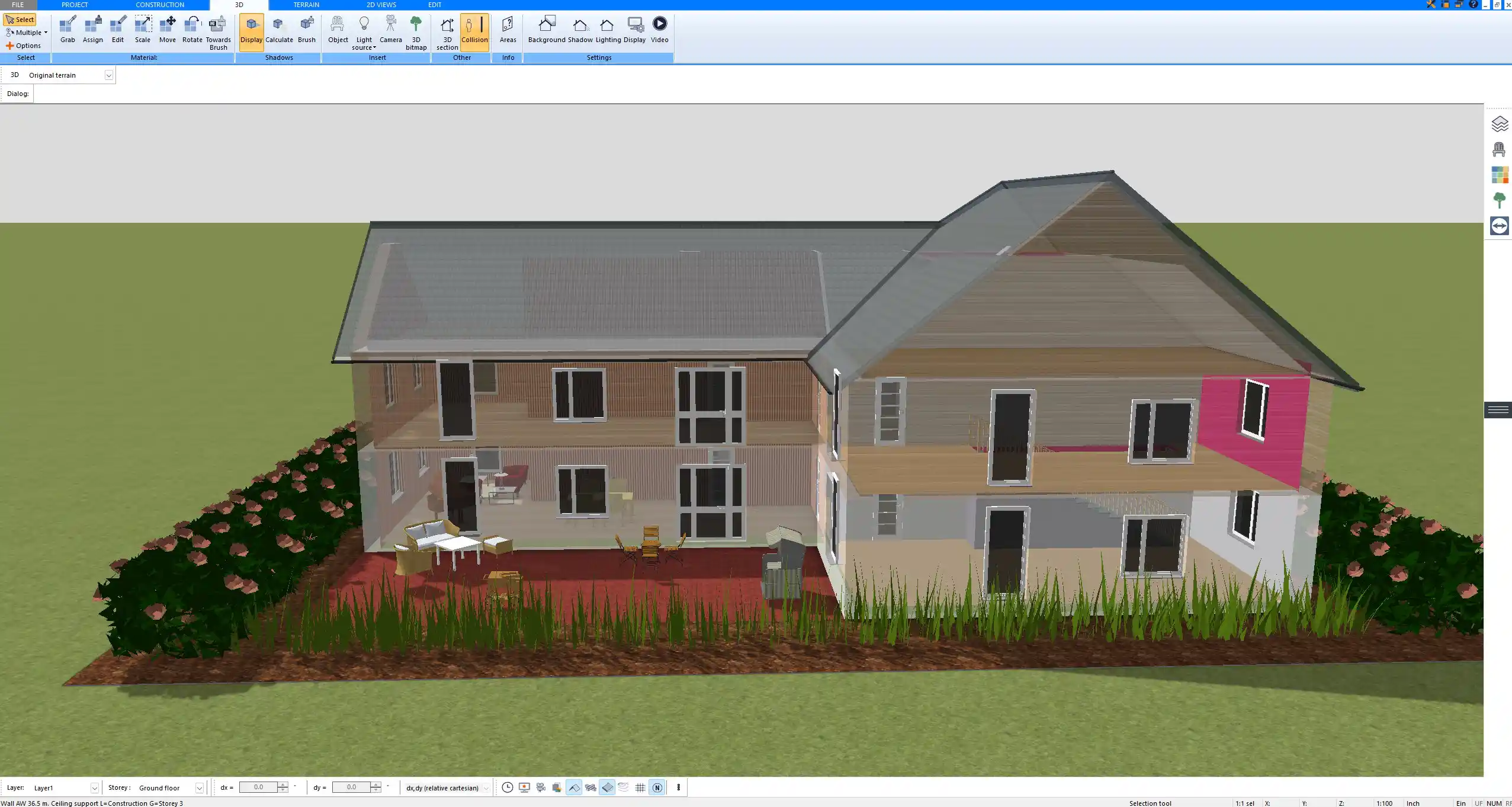
Complete construction drawing layout sheet with floor plan and elevations exported from Plan7Architect

Step 5 – Layout and Print

After creating floor plans, elevations, and sections, open the layout view.

Here you can:

  • Arrange multiple drawings on one sheet

  • Insert a title block

  • Add project name and date

  • Define print scale

  • Export as PDF

  • Print to scale

Before printing, verify:

  • Scale settings

  • Page format

  • Line thickness

  • Text readability

Always test print a sample page to confirm scale accuracy.

Metric and Imperial Measurement Support

Plan7Architect supports both European and American measurement systems.

You can:

  • Switch between metric and imperial units

  • Display dimensions in meters, centimeters, or millimeters

  • Display dimensions in feet and inches

  • Use fractional inch formatting

This makes the software suitable for projects in the United States, Canada, the United Kingdom, Australia, and throughout Europe. There is no need for manual unit conversion.

Can These Plans Be Used for Construction or Permit Submission?

The plans created in Plan7Architect are dimensionally accurate and created to scale. They are suitable for:

  • Construction planning

  • Contractor communication

  • Cost estimation

  • Design development

  • Renovation planning

For official permit submission, local regulations may require review, approval, or stamping by a licensed architect or engineer. Requirements vary by region.

Always verify:

  • Local building code requirements

  • Required drawing format

  • Required scale

  • Required professional certification

Customizing Elevations and Dimension Styles

Changing Dimension Appearance

You can modify:

  • Arrow style

  • Text size

  • Font

  • Line thickness

  • Decimal or fractional format

  • Offset distance from walls

This allows you to match common drafting standards used in your region.

For construction clarity, I prefer slightly thicker dimension lines for printed sets and smaller text for interior room dimensions.

Adjusting Elevation Graphics

Elevation appearance can be customized by:

  • Changing line weights

  • Hiding surface textures for technical drawings

  • Switching to black-and-white output

  • Displaying or hiding shadows

  • Adjusting detail level

For permit drawings, simple black-and-white line drawings are often preferred.

Common Mistakes When Creating Building Plans

Typical errors include:

  • Forgetting to set units before drawing

  • Mixing different drawing scales

  • Over-dimensioning the plan

  • Forgetting to dimension vertical heights

  • Printing without verifying scale

  • Placing dimension lines too close to walls

Avoid these mistakes by reviewing the drawing carefully before finalizing the layout.

Who Is Plan7Architect Suitable For?

Plan7Architect is suitable for:

  • Homeowners planning their own house

  • Builders and contractors

  • Draftsmen

  • Designers

  • Renovation planners

  • Property developers

Anyone who needs precise, scalable building plans with elevations and dimensions can use the software effectively.

Plan your project with Plan7Architect

Plan7Architect Pro

Plan7Architect Pro 5 for $109.99

You don’t need any prior experience because the software has been specifically designed for beginners. The planning process is carried out in 5 simple steps:

1. Draw Walls

Create your 2D floor plan by accurately drawing and adjusting rooms and walls for your home design.

2. Windows & Doors

Optimize your space layout with perfectly fitting door and window elements.

3. Floors & Roof

Visualize different levels and roof types for your home design.

4. Textures & 3D Objects

Choose materials and textures to customize floors, walls, and 3D objects individually for a realistic representation of your design.

5. Plan for the Building Permit

Sections and views for the building application can be created with Plan7Architect (1)
Create professional construction drawings with elevations, sections, and complete plan compilations.

6. Export the Floor Plan as a 3D Model for Twinmotion

Visualize your project with cutting-edge 3D technology and create high-quality image renderings and videos using Twinmotion by Epic Games.


  • – Compliant with international construction standards
  • – Usable on 3 PCs simultaneously
  • – Option for consultation with an architect
  • – Comprehensive user manual
  • – Regular updates
  • – Video tutorials
  • – Millions of 3D objects available

Why Thousands of Builders Prefer Plan7Architect

Why choose Plan7Architect over other home design tools?

14-Day Money-Back Guarantee
No questions asked. Just email us within 14 days if you’re not satisfied.
One-time payment – no subscription
Own the software forever. No hidden costs. No monthly fees. Updates are optional.
Based on $2,500 professional architecture software
Plan7Architect is an optimized version — used by professionals and private users alike.
Supports international building standards
Adaptable to US, UK, Canadian, Australian, and European requirements.
Works offline – use on up to 3 devices
No internet required. Install on up to 3 computers – ideal for home and office use.
Metric & imperial units
Switch freely between feet/inches or meters/centimeters — perfect for global use.
++
All key export/import formats included
DWG, DXF, OBJ, 3DS, STL, PDF, image export/import, and SketchUp import — for smooth collaboration.
ii
Create real building permit documents
Generate floor plans, elevations, cross-sections, and full construction drawings.
Supports wood framing for walls and roofs
Design wall and roof structures, gables, dormers, and freely constructed wood frameworks.
Easy learning curve with full support
Includes video tutorials, ticket system, detailed PDF manual, sample projects, and access to our customer forum.
Excellent verified reviews
Top ratings on Trusted Shops and Amazon.
Ongoing development – 3–4 updates per year
Always improving, with a modern 3D engine and regular feature upgrades.

Watch how a complete house is planned from start to finish – in under 25 minutes

Detailed House Planning (25 Min)

Small Home Planning Demo (12 Min)

The 3 Plan7Architects

Sale!
Plan7Architect Pro
Original price was: $259.99.Current price is: $109.99.

Verified Customer Reviews

Verified Customer Reviews

Trusted Shops:

Home » Building Plan Wiki » How to Create a Building Plan with Elevations and Dimensions
Youtube
Select your currency